What To Expect
Supporting Your Brain’s Natural Ability to Adapt and Thrive
At the Brain Enhancement Center, we work with the brain’s regulation systems and the networks that influence focus, emotional balance, and overall performance. Our process is structured, personalized, and collaborative—built to support meaningful, lasting change.
Your Experience at BEC
- What you’re experiencing
- What you’ve already tried
- What feels hardest right now
- What you’re hoping will change
Brain Map
See How Your Brain Actually Works
Next, you will come to the clinic for your brain map. A brain map is a detailed, real-time snapshot of how your brain is functioning. Using non-invasive technology like quantitative EEG (qEEG), small sensors are placed on the scalp to measure electrical activity across different regions of the brain. This process captures patterns related to focus, processing speed, emotional regulation, and nervous system balance. The result is a visual map that highlights how different areas of the brain are communicating and shows where activity may be overactive, underactive, or out of sync.
From there, we create a personalized plan that gently guides your brain toward better balance, clarity, and resilience. Rather than diagnosing conditions, a BEC brain map is used as a guide to understand how your brain is operating and where it may need support. It provides a baseline that informs personalized brain training and regulation strategies, helping the brain move toward more efficient and balanced patterns. Over time, follow-up maps can show how the brain is changing and adapting, giving a clear, measurable view of progress as it learns to function with greater clarity, resilience, and ease.
Train & Strengthen
After the brain map, we will be able to see exactly what areas of your brain are underperforming or overstimulated. We help your brain settle into more balanced, stable activity using gentle, non-invasive support that calms and organizes the nervous system. Through guided neurotraining, your brain learns new regulatory pathways. Neuromodulation is one of the ways we gently support your brain in settling into a more balanced state.
During this part of your session, you don’t need to do anything at all, we guide you through the process. Most people choose to simply relax as the brain is supported back to a healthier state. We use very low-level, non-invasive signals to gently “nudge” areas of the brain that may be overactive, underactive, or out of sync back toward better regulation. Many clients describe this as calming, like giving the nervous system a chance to reset. The goal is to help your brain feel more stable and supported, so it can function with greater ease.
Adjust & Deepen
As your brain begins to shift and respond, we continuously refine your sessions, helping you build on progress, stabilize improvements, and create lasting results. Using ongoing feedback and progress markers, we adjust the approach to support deeper regulation, stronger patterns, and continued growth. This phase is about building on your progress helping your brain stabilize, integrate changes, and move toward more lasting, effortless change.
Brain Map
See How Your Brain Actually Works
Next, you will come to the clinic for your brain map. A brain map is a detailed, real-time snapshot of how your brain is functioning. Using non-invasive technology like quantitative EEG (qEEG), small sensors are placed on the scalp to measure electrical activity across different regions of the brain. This process captures patterns related to focus, processing speed, emotional regulation, and nervous system balance. The result is a visual map that highlights how different areas of the brain are communicating and shows where activity may be overactive, underactive, or out of sync.
From there, we create a personalized plan that gently guides your brain toward better balance, clarity, and resilience. Rather than diagnosing conditions, a BEC brain map is used as a guide to understand how your brain is operating and where it may need support. It provides a baseline that informs personalized brain training and regulation strategies, helping the brain move toward more efficient and balanced patterns. Over time, follow-up maps can show how the brain is changing and adapting, giving a clear, measurable view of progress as it learns to function with greater clarity, resilience, and ease.
qEEG/Brain Map Results
Before Neurotherapy
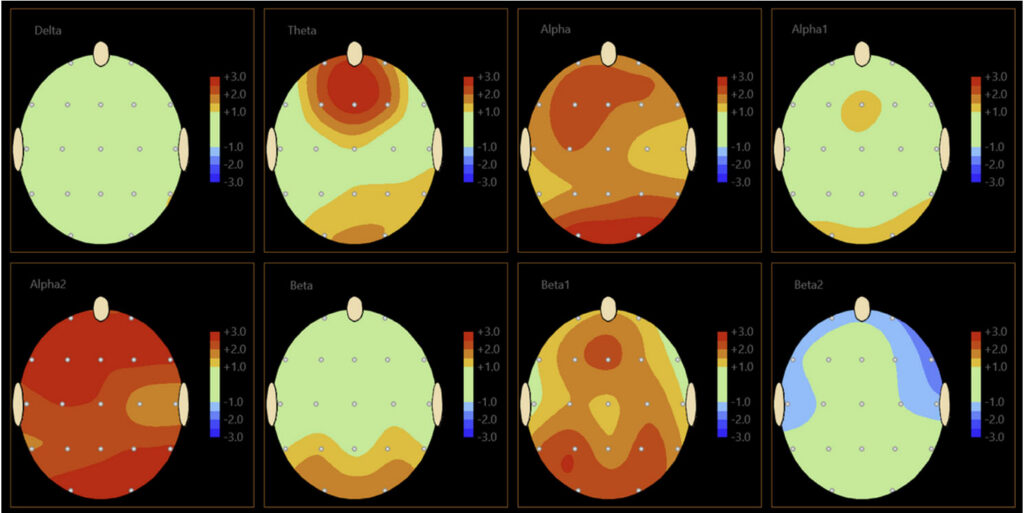
Poor communication,between networks
Stress, Anxiety, Fatigue, Brain Fog
After Neurotherapy
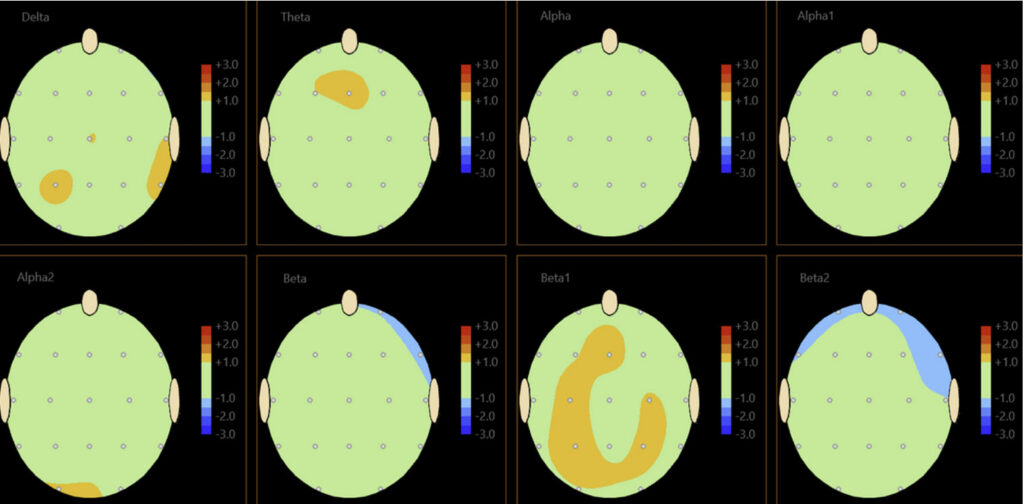
Improve communication
Calm, Clarity, Resilience
What To Expect For The qEEG
qEEG Brain Map (Quantitative EEG): is a non-invasive, process that records brain’s natural activity patterns, providing insight into how different regions are communicating and functioning.
1
Preparation
You’ll relax comfortably in a reclining chair while wearing a soft cap with small sensors placed on your head.
2
Recording Brain Activity
Well record your brain’s natural rhythms in two simple conditions:
– 10 minutes with eyes open
– 10 minutes with eyes closed
3
Functional Brain Tests
You’ll complete a brief set of computer-based tasks that assess:
- Attention
- Reaction time
- Processing speed
- Sensory integration
4
Heart Rate Variability Monitoring
We also measure Heart Rate Variability, which provides insight into your autonomic nervous system and how your body responds to stress and recovery.
5
Evaluations
You’ll complete a qEEG and a series of brief evaluations to guide your personalized neurotherapy plan.
6
Completion
Once recording is complete. we’ll gently remore the cap and clean off the sel. You’ll have time for questions, and we’ll schedule your follow-up visit to review your personalized report and discuss your recommended plan.
Sensory Note: There are no loud sounds, magnetic pulses, or electrical stimulation during your brain map.
We can easily adjust the environment to make it more comfortable for sensory-sensitive clients.
Help Your Brain Feel Calm, Clear, and Back in Balance
Contact us to schedule a free, 30-minute phone consultation to learn more and see if our services are right for you.
During this complimentary 30-minute session, you’ll meet with our team to:
- Share what you’ve been experiencing and what you’re hoping to improve
- Learn how brain mapping can provide insight into patterns affecting focus, mood, sleep, and overall regulation
- Explore our non-invasive, brain-based approaches designed to support balance and performance
- Get your questions answered about how the process works
- Receive personalized guidance on the next best step based on your goals