
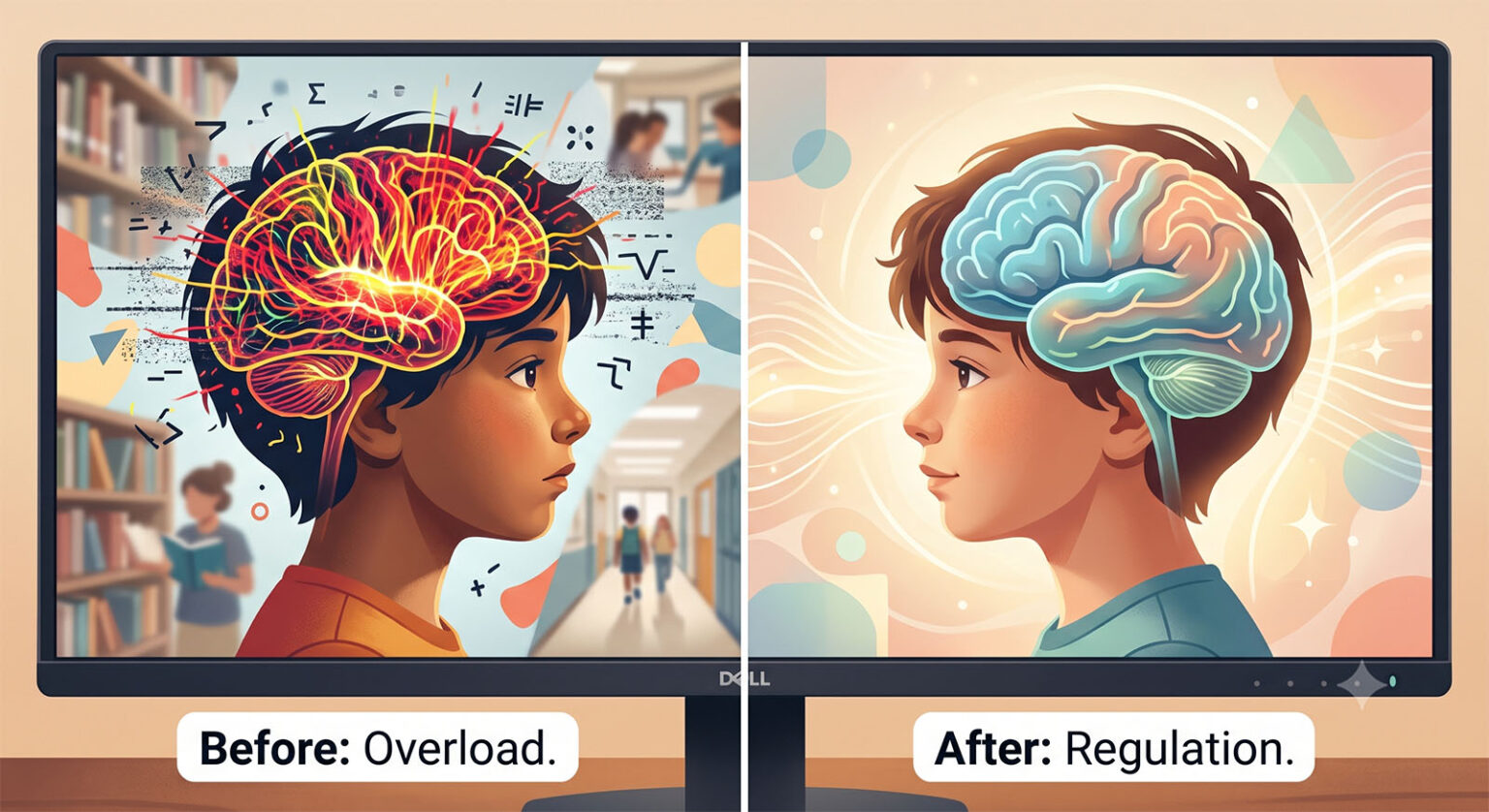
What We See at Brain Enhancement Center
When your child is autistic, you quickly learn that no two brains, bodies, or support needs are exactly alike.
You may have tried different therapies, routines, school supports, sensory strategies, or communication tools. Some may have helped. Others may not have fully addressed what you see every day: anxiety, overwhelm, sleep challenges, difficulty with transitions, sensory sensitivity, attention struggles, or moments when your child seems unable to access what they know.
For many families, the biggest question becomes:
What is happening beneath the surface, and how can we support the brain more effectively?
At Brain Enhancement Center, we approach autism from a foundation of presuming competence and looking deeper. We do not use brain mapping or neurofeedback to “treat autism” as something to erase. Instead, we use these tools to better understand each individual brain and support regulation, communication access, sleep, focus, sensory processing, and overall well-being.
Understanding the Brain Beneath the Surface
Autism is often described through outward traits, such as communication differences, sensory sensitivities, repetitive movements, or difficulty with transitions. But those visible experiences are often shaped by how the brain and nervous system are processing information, managing stress, and coordinating the body.
For example:
- A child who avoids eye contact may be experiencing sensory overload
- Difficulty with transitions may reflect challenges with flexibility or regulation
- Repetitive movements or behaviors may help create predictability, rhythm, or calm
- Limited or unreliable speech may reflect motor planning, regulation, or communication access challenges
At Brain Enhancement Center, we start with brain mapping using a customized qEEG, which offers a way to look at these underlying patterns.
During a qEEG, sensors are placed on the scalp to measure brainwave activity. This allows us to identify patterns such as:
- Elevated fast-wave activity, which may be associated with heightened stress or hyperarousal
- Slower brainwave patterns, which may relate to attention or processing speed challenges
- Imbalances between brain regions, which may affect communication, regulation, and coordination
For many families, this provides a new layer of understanding, one that goes beyond what is visible on the surface.
What Is Neurofeedback and How Does It Work?
Once we’ve mapped how the brain is functioning, neurofeedback becomes a way to gently support more efficient and regulated activity.
Neurofeedback is a brain-based process that provides real-time information about brain activity, allowing the brain to recognize and adjust its own patterns.
During a session, sensors are placed on the scalp to monitor activity. The individual engages with a video or sound that responds moment-to-moment to what the brain is doing. As the brain moves toward more stable and organized activity, it receives immediate positive feedback.
Rather than being directed or forced, the brain begins to self-correct—reinforcing patterns that are more balanced and adaptable.
Over time, this process may support the brain’s ability to:
- Maintain more consistent states of regulation
- Shift out of less efficient or reactive patterns
- Respond to internal and external demands with greater flexibility
Importantly:
- Neurofeedback is non-invasive
- It does not force change
- It supports the brain’s natural capacity to adapt, often referred to as neuroplasticity
Sessions are designed to be comfortable and are adjusted over time based on how the brain responds.
What We See in Practice
Every autistic individual is different, and outcomes can vary. That said, there are some areas where families often report meaningful changes over time.
Regulation and Emotional Flexibility
Many parents notice that their child is better able to move through moments of frustration or stress, with fewer intense reactions or shorter periods of overwhelm.
Attention and Engagement
Some individuals show improved ability to stay with tasks, follow through on activities, or engage more consistently with others.
Sensory Processing
Sounds, textures, or environments that once felt overwhelming may become more manageable, allowing for greater participation in everyday experiences.
Sleep
As brain patterns become more regulated, families sometimes report improvements in sleep, such as falling asleep more easily or staying asleep more consistently.
Communication and Connection
This can look different for each person. Parents may notice more responsiveness, more interaction, more shared attention, or more reliable access to communication.
One of the most common things we hear is simple but powerful:
“Things just feel a little easier.”
How This Fits With Other Supports
Brain mapping and neurofeedback are not intended to replace other forms of support, such as:
- Speech or communication support
- Occupational therapy
- Educational services
- Counseling or emotional support
- Other therapeutic services
Instead, they are often used alongside these supports.
By helping the brain move toward more regulated patterns, individuals may be better able to engage with and benefit from the therapies and supports they are already using.
Why a Personalized Approach Matters
Autism reflects a wide range of differences in how the brain functions, which is why personalization is so important.
At Brain Enhancement Center, everything begins with understanding the individual brain.
A qEEG brain map helps guide:
- Where to focus neurofeedback sessions
- How sessions are adjusted over time
- How changes in brain activity are tracked
- Which patterns may be connected to specific challenges
As patterns shift, the approach can evolve, making the process responsive and tailored to the individual.
What the Research Says
Research on qEEG brain mapping and neurofeedback for autistic individuals is still evolving, but several studies show encouraging patterns.
Some studies suggest neurofeedback may support attention, memory, processing, and overall brain regulation. In one review of multiple studies, most showed improvements in cognitive skills such as focus and processing.
https://pmc.ncbi.nlm.nih.gov/articles/PMC11994135
Other research has shown changes in how the brain communicates within itself after neurofeedback, along with improvements in communication, social interaction, and behavior in some children.
https://www.sciencedirect.com/science/article/abs/pii/S0166432825000117
Earlier studies have also found improvements in areas such as social skills, communication, and executive functioning, including planning, flexibility, and follow-through, with some benefits lasting beyond the sessions themselves.
https://www.sciencedirect.com/science/article/abs/pii/S175094670900110X
For families, these changes may show up as small but meaningful shifts, such as:
- More consistent attention
- Smoother transitions
- Improved sleep
- Greater emotional flexibility
- More responsiveness
- Better participation in daily routines
- Increased moments of connection
At the same time, it is important to keep expectations realistic. Many studies are small or use different methods, and researchers agree that more large-scale studies are still needed to better understand long-term outcomes.
https://raisingchildren.net.au/autism/therapies-guide/neurofeedback
Brain mapping research also shows that qEEG can help identify differences in how the brain is functioning and communicating in autistic individuals.
https://pmc.ncbi.nlm.nih.gov/articles/PMC3733024
This means brain mapping may provide helpful insight into your child’s unique neurological patterns, so care decisions are not based on guesswork alone.
Is This the Right Fit for Your Family?
Brain mapping and neurofeedback may be worth exploring if:
- Your child experiences frequent dysregulation or sensory overwhelm
- Attention and focus are ongoing challenges
- Sleep patterns are inconsistent
- Transitions are difficult
- Anxiety or emotional reactivity affects daily life
- You are looking for a non-invasive, non-medication approach
- You want more insight into how your child’s brain is functioning
Even starting with a conversation can help you better understand whether these approaches align with your goals.
A Different Way to Look at Progress
rogress does not always show up as a dramatic shift.
Sometimes it looks like:
- A smoother transition between activities
- A calmer response to stress
- More consistent routines
- Better sleep
- More reliable communication
- More moments of engagement and connection
At Brain Enhancement Center, these day-to-day changes are meaningful indicators of how the brain is adapting over time.
Curious About What This Could Look Like?
If you are interested in learning more about brain mapping and neurofeedback, Brain Enhancement Center can help you explore whether these approaches are a good fit for your child, teen, or loved one.
Schedule a consultation to learn more about how we support autistic individuals through personalized, brain-based approaches designed to improve regulation, sleep, focus, communication access, and overall well-being.